Engine would not start after a good sail.
The problem, the cause, and the fix…
Having being sailing, when we would return we would try to start the engine. It would crank, and crank, and crank, and crank, but not fire.
Which resulted in us sailing back to our dock spot: on more than one occasion!!! It made us very, very frustrated.
Eventually, after maybe 15 minutes of trying, and letting it rest, etc, the engine would start, but it sounded, and felt, like only one or two cylinders were firing. It was fragile, but after some time (a few minutes) the engine would start sounding better and more powerful, and eventually roar into life, and we would be in business. But obviously that is not an acceptable engine starting process.
I thought it was my starting technique, and maybe I was flooding the engine. I also thought maybe the fuel was causing the problem. Or maybe it was water getting back into the system from all the cranking (prior to closing the seacock).
I was dumbfounded and none of my theories were proving viable.
I was to the point where I was about to take the carb apart, and work on the fuel system, but before I got into that project, I was talked into first calling the Atomic-4 guru himself; Mr. Don Moyer.
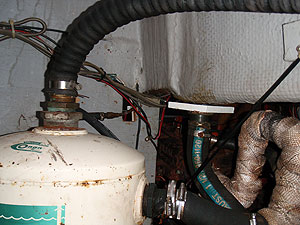 Don was great on the phone – he is such a kind person, so sharing with his immense knowledge, and incredibly patient and caring. Don listened to all my symptoms, all my theories, and asked some probing questions. After it all, Don said that all the symptoms were perfectly aligned with water/dampness in the cylinders. The "final nail in the coffin" as Don put it, was that I had a small amount of water in the oil (milky oil on dipstick). His assurances let me know that I should not begin taking the fuel system apart, but instead focus all my efforts on the raw water cooling and exhaust system.
I went over all the usual things, but everything was looking good. I eventually came to a theory that the wet lift muffler was pouring exhaust water back into the engine exhaust system every time we were heeled on the Port board. My fix plan was to move the muffler to fore and aft alignment so as to not have it pour directly back towards the engine on port tack.
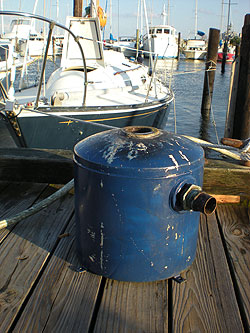 My theory was wrong, but as it happened, it led me directly to the real problem… I removed the muffler to paint it, and it was full of water. I had to be careful lifting it out of the locker so as not to pour the exhaust water everywhere. That didn’t sit right with me, and got me to researching how exactly the wet lift muffler works. My research showed that the water level should not be more than a couple of inches, but mine was the full 8 or so inches right up to the intake!
Muffler with the exhaust/out nipple removed.
(Needed a welding flame’s heat to remove it – thanks Cobbs)
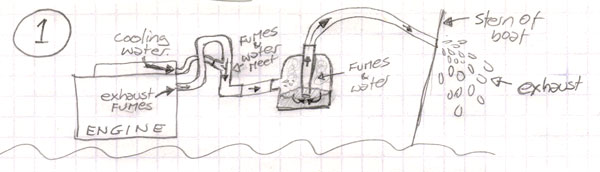
(1) The full wet-lift muffler exhaust system explained:
(2) How a wet-lift muffler works:
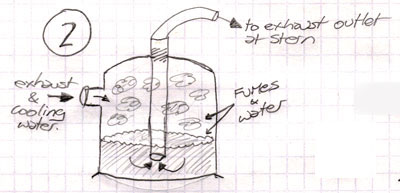
With the muffler chock full of water, clearly, there was my problem.
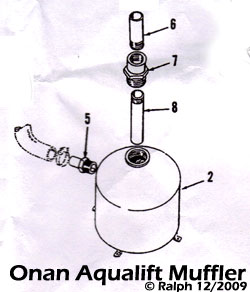
Turns out the lift pipe in the muffler (item 8 in the exploded diagram to right) was PVC, and had melted away to just a melted blob at the muffler exhaust outlet. It was not a pipe anymore, and thus nothing was there to extract the water from the muffler.
Onan Aqualift wet-lift Muffler Exploded Parts diagram:
(3) What I had, because the PVC lift pipe was missing:
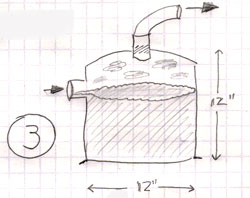
To this day I do not know how water ever came out the exhaust at the back of the boat while the engine was running without that water lift pipe! It must have been 100% back pressure! Who knows how much water was flowing back into the engine head????
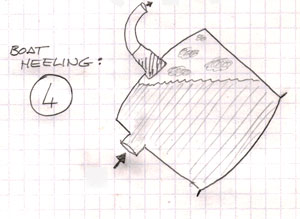 At left (4) is what I imagine my muffler looked like with no wet lift pipe, and the boat heeling, thus; presumably pouring the exhaust water back towards the engine!
Anywhoo, with some difficulty, and over a week or so I found a replacement part for the water lift, and installed it. This one is Galvanized steel, so it won’t melt. Put the rebuilt muffler back in place, and did 4 oil changes to get all the milky oil out of the system. And we are in business!!!
The engine starts and runs great, even after some good sailing – heeling on both boards! And perfectly clean oil too (no water). Problem solved & life is good. The problem had existed since we got the boat in August, and once I narrowed it down to the Muffler, it took me about 6 weeks to get everything squared away.
Questions?? Send me an e-mai1: great_breeze(at)yahoo(dot)com
© Ralph, 12/29/09.